In an article in The Guardian Andrew Hindmoor, professor of politics at the University of Sheffield criticizes Jeremy Corbyn and Labour and the left in general as setting an ideological agenda that sees "an unduly bleak view of recent British history, apt to see little but a legacy of neoliberalism, ignores the advances of social democracy and erodes faith in progressive politics."
"Our sense of history shapes how we think about who we are. One of the distinguishing features of the left in Britain is that it holds to a remorselessly bleak and miserabilist view of our recent politics. This is a history in which Margaret Thatcher’s election in 1979 marked the start of a still continuing fall from political grace made evident by the triumph of a free-market, get-what-you-can, neoliberal ideology, dizzying levels of inequality, social decay, rampant individualism, state authoritarianism and political corruption."
But Hindmoor, a "left-centrist" argues the left have got this all wrong. That things have only got better. For all of us. But we're blind to this because of this ideological stance that Thatcher and successive Tory government have robbed the poor to feed the rich.
"I think that this history is wrong and self-harming. It is wrong because Britain has in many (although certainly not all) respects become a more politically attractive and, much as I cringe whenever I hear this term, progressive country over the past few decades. It is self-harming because this bleak history undermines faith in politics. Britain is not a social democratic paradise. But it is a long way from being a poster child for neoliberalism. Leftwing ideas and arguments have shaped and continue to shape our politics."
Right, so we assume Hindmoor has some compelling arguments for this somewhat rosier view of the last 39 years? Well, oddly he doesn't have much. But he does list all the things that have gone wrong with Britain since that fateful day on the 3rd May 1979 when Margaret Thatcher with the resounding backing of a third of the electorate stormed into power.
"The Corbynite left thrives on an absolutist sense of history. May 1979 and the Conservatives’ general election victory was a year zero. Since then, everything that could have gone wrong has gone wrong. The Conservatives have won seven of the past 10 elections. And when they lost, that did not really count because New Labour was basically no different. Neoliberalism is and remains the ideology of the age to which all other evils can be traced."
There's much of this in the piece, this is over half way in and Hindmoor has still yet to show us that none of this is true.
We get all the usual straw man arguments, the left are cynics, pessimists, miserabilists: "Yet whatever the important differences, a miserabilist sense of history has become the new normal. This is crucial because miserabilism undermines faith in political centrism. If you genuinely believe that everything is awful, then a centre-left or centre-right political party and political attitude suddenly look a lot less appealing. Also, miserabilism is tough to argue with."
It is if you don't offer anything to counter it other than anecdotes and longwinded diatribes.
He then spends much of the middle of the article mansplaining what politics is, because we're all idiots who have no idea what this thing be.
"Politics is the activity through which we collectively talk and decide about who we want to be. At its best, it is about setting inspiring goals, challenging power and transforming people’s lives. But on a day-to-day basis, it is also about concessions and compromises; tactical alliances; arguments and betrayals; U-turns and hypocrisies; and a never-ending sequence of policy failures and scandals. Politics is, as the German sociologist Max Weber once observed, the slow boring of hard boards. It takes time and is not always very pleasant to do. There is a chasm between the promise of what politics can sometimes achieve and the reality of what it involves.
Democratic politics is therefore always going to involve compromises and it is always going to be a laborious process involving talking to and negotiating with people you think are exceptionally condescending and routinely ill-informed. The other reason the chasm arises is that politics, if it is going to make a difference, has to be about getting things done. This means designing and implementing policies and that is something that..."
Hindmoor goes on like this for some time as if he's fronting an introductory politics lesson. I don't know about you but I'm still waiting for this evidence that since 1979 things have really been looking up and is not at miserable in any way.
"This does not mean that Britain is a social democratic paradise," he repeats. "But I believe there is an alternative history of modern Britain in which failures are described alongside measured successes."
On and on making statements with absolutely no evidence whatsoever...
"Neoliberalism is a long way from being the all-conquering hegemonic discourse the Corbynite left claims it to be. Indeed, neoliberalism has been pretty much disowned by the leaders of all the largest political parties. As I have already noted, public opinion remains centrist by ideological inclination but distinctly left of centre on most substantive policy issues. There is little evidence that a generation of voters reared under New Labour and the coalition has shifted to the right."
So little evidence that none is cited. For anything.
It goes on and on like this for three quarters of the article basically regurgitating the same trope in a number of different ways without anything even remotely looking like evidence. Until finally....
"Between 2001 and 2009, overall public expenditure in real, that is, inflation-adjusted terms increased by 42%." Now why on earth does that statistic end at 2009 the year after the financial crash, enormous bail out and the beginning of the austerity project I wonder?
What public spending figures (almost) always hide is an ageing population. After debt, the increases in public spending come from the NHS and pension data. In real terms other areas have not experienced spending growth (and some budgets, defence, policing, prison service, social care, etc. have been severely cut). The social security budget, for instance, the welfare fund for the most vulnerable, has been both slashed for those claiming benefits and not working (there's been a 4 year freeze which is an effective cut) while it has gone up overall because of the numbers claiming 'top up' benefits like Tax Credits and housing benefit which have risen markedly as wages stagnated and more fell into low pay or were forced into part time or zero contract work:
 As percentage "other social security" costs have fallen whilst the numbers claiming have risen.
 And spending projections are all downwards...


Hindmoor then adds: "Health expenditure increased by 75%." This is a fact. However, it doesn't take into account the growth in population:


"All the evidence is that the investment in public services in the 2000s paid off in terms of better health outcomes and exam results and that the poorest families were among the greatest beneficiaries.[my italics]"
First off, healthier?

 Really? We're walking less and eating more. Health experts argue that current rates of obesity will lead to an explosion in coronary diseases and cancer, primarily because of the growth in obesity among younger age groups:


While exam results continue to rise teacher unions consistently criticize the structure of education (just pop in children taught pass exams in google for too numerous articles to cite) as the curriculum is now structured to pass SATs, 12+ and final exams and reaching key stages. Art and music are no longer on the curriculum, simply because they do not fit the rote model learning.
The National Union of Teachers website:
"Those children from disadvantaged backgrounds who need a broad and balanced curriculum the most are least likely to receive it, given the amount of time schools will feel required to devote to the core subjects to achieve that notional but dubious “mastery” of subject content. Because of the perceived pressures of inspection and testing many schools will feel constrained to follow the yearly or two-yearly syllabuses..."
And Academics argued in an open letter to the education secretary:
The curriculum promotes “endless lists of spellings, facts and rules.”
The academics, all of whom are either professors of education or teach in university education departments, write: “This mountain of data will not develop children’s ability to think – including problem-solving, critical understanding and creativity.”
Schools "put further emphasis on memorisation and rote learning rather than understanding.”
As to Andrew Hindmoor's biggest and most important claim " the poorest families were among the greatest beneficiaries." What is his evidence?
"The median household’s final income (after accounting for taxes, welfare benefits and spending on public services) is now 95% higher than it was in 1997/8."
I'm no economist but that does not show the poorest families are better off. It simply shows the median income has almost doubled. What if that increase is primarily fuelled by the highest earners increasing their income?
He offers no breakdown of data but suggests:
"The minimum wage and tax credits made a tangible difference to people’s lives and Britain remains a country in which a great deal of redistribution takes place. The final income of the poorest 10% of households is three times greater than their market income prior to welfare payments and public service provision."
I genuinely have no idea what that means. The figure most often cited to show (and the media actually reports it this way) that the poor are getting richer and the rich poorer is from The Office of National Statistics data ONS which most recently found:
"Median disposable income for the poorest fifth of households rose by £700 (5.1%) between 2014/15 and 2015/16; in contrast the income of the richest fifth of households fell by £1,000 (1.9%) over the same period."
And their finding was "There has been a gradual decline in income inequality in the last 10 years, with levels similar to those seen in the mid to late 1980s."
Unfortunately this is a complete distortion of data. For a start, in the bottom 20 percentile in ONS data this includes a wide group of people that includes those on benefits, the poorest, who have (by having a benefit freeze for four years) seen a deficit in income. The data does not include housing costs, which have risen at about 8% over the last five years, it doesn't include benefit penalties like the so called bedroom tax on unused 2nd bedrooms, it doesn't include the new 25% council tax payment that everyone (including those up to two years ago receiving 100% benefit) now have to pay (on average between £100-150 per annum), it doesn't include data on those under 25 who can no longer claim housing benefit, those under 19 who can claim no benefit, it doesn't include data on those that are excluded from the benefit system from the recently implemented benefit sanctions. It is, to all intents and purposes impossible to know exactly how all these factors impinge on the lowest net incomes. It's likely that the changes in the income tax threshold gave theoretical increases in disposable income which were mostly gobbled up by rising costs in housing, food, childcare and transport costs (those once unemployed and now employed often have to factor in transport costs to work).
The problem is that when we're talking of increases in hundreds of pounds for those beneath the £12, 600 tax limit, factors like rising costs have a far more detrimental effect than those on higher wages. Furthermore, public spending cuts to areas like the police, social services, environmental services, the privatisation of public transport and utilities have a much worse effect on those in both the lowest percentile and the poorest areas and these are not factored into the data.
The most damning criticism of the ONS data is, one, it includes the top 20% earners, where all data shows that those in the top 1% have enjoyed enormous increases, so including the next 19% below the top 1% threshold horribly skewers the data:
 The other key factor in top end earners is that the ONS data does not include assets and that is where the richest percentiles gain the most profit.
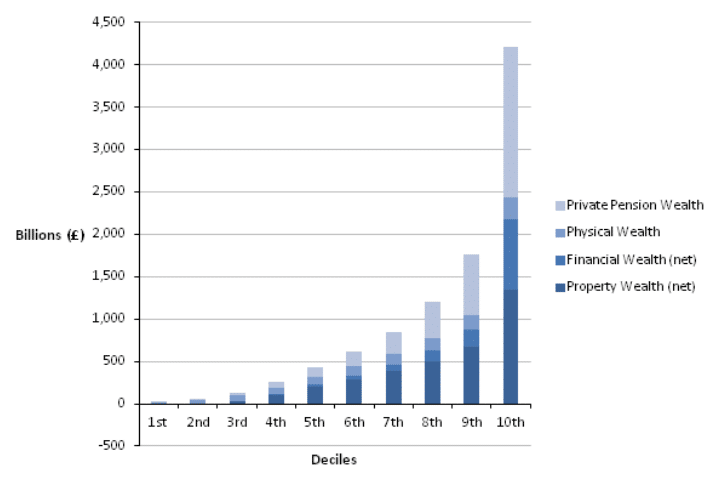
So that data is next to worthless.
Unfortunately, he offers no evidence in support of this and, in The Guardian 14/3/18 there's a piece by Jonathan Portes, professor of economics and public policy at King’s College London which argues:
"Our analysis shows that...changes to taxes and welfare payments since 2010 have indeed hit the poorest hardest, whether you look at the record of the 2010-15 coalition government or that of the Conservative government elected in May 2015. Some changes, such as increases in the personal allowance and the minimum wage, have boosted incomes; but others, especially cuts to benefits and tax credits, more than offset this.
Looking both backward and forward, by 2021-22 the overall impact of all these changes will have been to reduce the net incomes of the poorest fifth of households by about a tenth, on average, while making little or no difference to the incomes of the richest fifth."
Hmmm.
That is all the data that Hindmoor offers in defence of his position. Though, oddly, he goes on to list all the things "that could have gone wrong" which have indeed "gone wrong":
He argues the left see:
"The welfare state has been pulled apart. Public services have been devastated. Inequality is out of control and has pushed us to the edge of social breakdown. The bankers have got away with it and nobody has been held to account for what happened in 2008. The environment is being destroyed. The political system is broken and politicians are invariably corrupt."
But doesn't offer any argument to counter these assertions because, well, they're just obviously true.
And there's more. He argues:
"Many things have gone wrong that we need to do everything we can to start to fix. Obvious candidates include housing, homelessness, zero-hours contracts, universal credit, regional policy, wealth inequality, mental health care, investment and productivity and the innumerable health and social care challenges posed by an ageing population."
He could also include prison numbers, the rise in home grown terrorism, trafficking, modern slavery, increase in drug crime, in violent crime, a huge decrease in social mobility, the widespread growth of academy schools under the umbrella of segregating religions (Jewish, CofE, Catholic and Islamic faith schools), hate crime rates, racial attacks, social media hate crime, gentrification, the loss of social housing stock, building on brownfield and greenbelt, tax avoidance, tax cuts for the richest and corporation tax cuts, and I could go on and on.
Ultimately, Hindmoor is suggesting that "the Corbynite left" see the last 39 years of Tory and New Labour rule as a huge swing far to the right whereas in fact those governments have been following a centrist politics, that, in fact, things are much rosier than the miserablist left see them, that people already hold many left of centre views (he doesn't mention Brexit oddly) but these have to be catered to within a sensible centrist government not a backward looking diversive politics of the past and wanting a left wing social democratic government is nostalgic and out of step with a forward looking global economy.
Though, of course, this inequality (neo-liberal even if no one calls it that) we're experiencing fosters things like political indifference, hatred of minorities, the rise of the extreme right. People are not rational, it doesn't follow that the poorest will flock to a left wing Labour who offers a return to high tax on the rich and public service expenditure. The Brexit campaign and Osborne's strivers and shirkers rhetoric fostered this divisive nature. I have no idea how you make things better, throwing cash at things is not always effective, however, austerity might appear to have been a fiscal success but it hides the fact that it was completely unnecessary and was merely an ideological weapon to cut public services.
We're told a conflicting message that public debt is bad, private debt is good. The deficit must be cut but you must strive to be tied to tuition and student loan debt, mortgage debt, personal finance debt, these are the highest calling, in fact the economy completely relies on this personal debt. In reality, the opposite is the case, public debt can effectively be easily written off, borrowing costs are at an all time low, yet private borrowing via student costs, rising housing cost and personal financial borrowing are worse than ever. If you're under 30 your lot is definitely worse in almost every area than it was for my generation of the 35-55s. If you are poor you are getting poorer, inequality is widening, social mobility is stagnant, the rich hide their wealth in offshore accounts, corporations actively avoid any tax, the poorest are forced into zero hour flexible work, the state pension age rises like a tantalising glimpse on the horizon, the environment is screwed beyond redemption, homelessness rises, social housing has been sold off and the young can't afford to leave home (assuming they have a home), benefits are cut in real terms, mental illness rises while mental health provision is cut, we're getting fatter, older, more violent, less tolerant. Why on earth would anyone not want a return to the leftist social democracy of the pre-Thatcher Labour party?
"Our sense of history shapes how we think about who we are. One of the distinguishing features of the left in Britain is that it holds to a remorselessly bleak and miserabilist view of our recent politics. This is a history in which Margaret Thatcher’s election in 1979 marked the start of a still continuing fall from political grace made evident by the triumph of a free-market, get-what-you-can, neoliberal ideology, dizzying levels of inequality, social decay, rampant individualism, state authoritarianism and political corruption."
But Hindmoor, a "left-centrist" argues the left have got this all wrong. That things have only got better. For all of us. But we're blind to this because of this ideological stance that Thatcher and successive Tory government have robbed the poor to feed the rich.
"I think that this history is wrong and self-harming. It is wrong because Britain has in many (although certainly not all) respects become a more politically attractive and, much as I cringe whenever I hear this term, progressive country over the past few decades. It is self-harming because this bleak history undermines faith in politics. Britain is not a social democratic paradise. But it is a long way from being a poster child for neoliberalism. Leftwing ideas and arguments have shaped and continue to shape our politics."
Right, so we assume Hindmoor has some compelling arguments for this somewhat rosier view of the last 39 years? Well, oddly he doesn't have much. But he does list all the things that have gone wrong with Britain since that fateful day on the 3rd May 1979 when Margaret Thatcher with the resounding backing of a third of the electorate stormed into power.
"The Corbynite left thrives on an absolutist sense of history. May 1979 and the Conservatives’ general election victory was a year zero. Since then, everything that could have gone wrong has gone wrong. The Conservatives have won seven of the past 10 elections. And when they lost, that did not really count because New Labour was basically no different. Neoliberalism is and remains the ideology of the age to which all other evils can be traced."
There's much of this in the piece, this is over half way in and Hindmoor has still yet to show us that none of this is true.
We get all the usual straw man arguments, the left are cynics, pessimists, miserabilists: "Yet whatever the important differences, a miserabilist sense of history has become the new normal. This is crucial because miserabilism undermines faith in political centrism. If you genuinely believe that everything is awful, then a centre-left or centre-right political party and political attitude suddenly look a lot less appealing. Also, miserabilism is tough to argue with."
It is if you don't offer anything to counter it other than anecdotes and longwinded diatribes.
He then spends much of the middle of the article mansplaining what politics is, because we're all idiots who have no idea what this thing be.
"Politics is the activity through which we collectively talk and decide about who we want to be. At its best, it is about setting inspiring goals, challenging power and transforming people’s lives. But on a day-to-day basis, it is also about concessions and compromises; tactical alliances; arguments and betrayals; U-turns and hypocrisies; and a never-ending sequence of policy failures and scandals. Politics is, as the German sociologist Max Weber once observed, the slow boring of hard boards. It takes time and is not always very pleasant to do. There is a chasm between the promise of what politics can sometimes achieve and the reality of what it involves.
Democratic politics is therefore always going to involve compromises and it is always going to be a laborious process involving talking to and negotiating with people you think are exceptionally condescending and routinely ill-informed. The other reason the chasm arises is that politics, if it is going to make a difference, has to be about getting things done. This means designing and implementing policies and that is something that..."
Hindmoor goes on like this for some time as if he's fronting an introductory politics lesson. I don't know about you but I'm still waiting for this evidence that since 1979 things have really been looking up and is not at miserable in any way.
"This does not mean that Britain is a social democratic paradise," he repeats. "But I believe there is an alternative history of modern Britain in which failures are described alongside measured successes."
On and on making statements with absolutely no evidence whatsoever...
"Neoliberalism is a long way from being the all-conquering hegemonic discourse the Corbynite left claims it to be. Indeed, neoliberalism has been pretty much disowned by the leaders of all the largest political parties. As I have already noted, public opinion remains centrist by ideological inclination but distinctly left of centre on most substantive policy issues. There is little evidence that a generation of voters reared under New Labour and the coalition has shifted to the right."
So little evidence that none is cited. For anything.
It goes on and on like this for three quarters of the article basically regurgitating the same trope in a number of different ways without anything even remotely looking like evidence. Until finally....
"Between 2001 and 2009, overall public expenditure in real, that is, inflation-adjusted terms increased by 42%." Now why on earth does that statistic end at 2009 the year after the financial crash, enormous bail out and the beginning of the austerity project I wonder?
What public spending figures (almost) always hide is an ageing population. After debt, the increases in public spending come from the NHS and pension data. In real terms other areas have not experienced spending growth (and some budgets, defence, policing, prison service, social care, etc. have been severely cut). The social security budget, for instance, the welfare fund for the most vulnerable, has been both slashed for those claiming benefits and not working (there's been a 4 year freeze which is an effective cut) while it has gone up overall because of the numbers claiming 'top up' benefits like Tax Credits and housing benefit which have risen markedly as wages stagnated and more fell into low pay or were forced into part time or zero contract work:


Hindmoor then adds: "Health expenditure increased by 75%." This is a fact. However, it doesn't take into account the growth in population:

And the ageing population:


"All the evidence is that the investment in public services in the 2000s paid off in terms of better health outcomes and exam results and that the poorest families were among the greatest beneficiaries.[my italics]"
First off, healthier?


While exam results continue to rise teacher unions consistently criticize the structure of education (just pop in children taught pass exams in google for too numerous articles to cite) as the curriculum is now structured to pass SATs, 12+ and final exams and reaching key stages. Art and music are no longer on the curriculum, simply because they do not fit the rote model learning.
The National Union of Teachers website:
"Those children from disadvantaged backgrounds who need a broad and balanced curriculum the most are least likely to receive it, given the amount of time schools will feel required to devote to the core subjects to achieve that notional but dubious “mastery” of subject content. Because of the perceived pressures of inspection and testing many schools will feel constrained to follow the yearly or two-yearly syllabuses..."
And Academics argued in an open letter to the education secretary:
The curriculum promotes “endless lists of spellings, facts and rules.”
The academics, all of whom are either professors of education or teach in university education departments, write: “This mountain of data will not develop children’s ability to think – including problem-solving, critical understanding and creativity.”
Schools "put further emphasis on memorisation and rote learning rather than understanding.”
As to Andrew Hindmoor's biggest and most important claim " the poorest families were among the greatest beneficiaries." What is his evidence?
"The median household’s final income (after accounting for taxes, welfare benefits and spending on public services) is now 95% higher than it was in 1997/8."
I'm no economist but that does not show the poorest families are better off. It simply shows the median income has almost doubled. What if that increase is primarily fuelled by the highest earners increasing their income?
He offers no breakdown of data but suggests:
"The minimum wage and tax credits made a tangible difference to people’s lives and Britain remains a country in which a great deal of redistribution takes place. The final income of the poorest 10% of households is three times greater than their market income prior to welfare payments and public service provision."
I genuinely have no idea what that means. The figure most often cited to show (and the media actually reports it this way) that the poor are getting richer and the rich poorer is from The Office of National Statistics data ONS which most recently found:
"Median disposable income for the poorest fifth of households rose by £700 (5.1%) between 2014/15 and 2015/16; in contrast the income of the richest fifth of households fell by £1,000 (1.9%) over the same period."
And their finding was "There has been a gradual decline in income inequality in the last 10 years, with levels similar to those seen in the mid to late 1980s."
Unfortunately this is a complete distortion of data. For a start, in the bottom 20 percentile in ONS data this includes a wide group of people that includes those on benefits, the poorest, who have (by having a benefit freeze for four years) seen a deficit in income. The data does not include housing costs, which have risen at about 8% over the last five years, it doesn't include benefit penalties like the so called bedroom tax on unused 2nd bedrooms, it doesn't include the new 25% council tax payment that everyone (including those up to two years ago receiving 100% benefit) now have to pay (on average between £100-150 per annum), it doesn't include data on those under 25 who can no longer claim housing benefit, those under 19 who can claim no benefit, it doesn't include data on those that are excluded from the benefit system from the recently implemented benefit sanctions. It is, to all intents and purposes impossible to know exactly how all these factors impinge on the lowest net incomes. It's likely that the changes in the income tax threshold gave theoretical increases in disposable income which were mostly gobbled up by rising costs in housing, food, childcare and transport costs (those once unemployed and now employed often have to factor in transport costs to work).
The problem is that when we're talking of increases in hundreds of pounds for those beneath the £12, 600 tax limit, factors like rising costs have a far more detrimental effect than those on higher wages. Furthermore, public spending cuts to areas like the police, social services, environmental services, the privatisation of public transport and utilities have a much worse effect on those in both the lowest percentile and the poorest areas and these are not factored into the data.
The most damning criticism of the ONS data is, one, it includes the top 20% earners, where all data shows that those in the top 1% have enjoyed enormous increases, so including the next 19% below the top 1% threshold horribly skewers the data:

So that data is next to worthless.
Unfortunately, he offers no evidence in support of this and, in The Guardian 14/3/18 there's a piece by Jonathan Portes, professor of economics and public policy at King’s College London which argues:
"Our analysis shows that...changes to taxes and welfare payments since 2010 have indeed hit the poorest hardest, whether you look at the record of the 2010-15 coalition government or that of the Conservative government elected in May 2015. Some changes, such as increases in the personal allowance and the minimum wage, have boosted incomes; but others, especially cuts to benefits and tax credits, more than offset this.
Looking both backward and forward, by 2021-22 the overall impact of all these changes will have been to reduce the net incomes of the poorest fifth of households by about a tenth, on average, while making little or no difference to the incomes of the richest fifth."
Hmmm.
That is all the data that Hindmoor offers in defence of his position. Though, oddly, he goes on to list all the things "that could have gone wrong" which have indeed "gone wrong":
He argues the left see:
"The welfare state has been pulled apart. Public services have been devastated. Inequality is out of control and has pushed us to the edge of social breakdown. The bankers have got away with it and nobody has been held to account for what happened in 2008. The environment is being destroyed. The political system is broken and politicians are invariably corrupt."
But doesn't offer any argument to counter these assertions because, well, they're just obviously true.
And there's more. He argues:
"Many things have gone wrong that we need to do everything we can to start to fix. Obvious candidates include housing, homelessness, zero-hours contracts, universal credit, regional policy, wealth inequality, mental health care, investment and productivity and the innumerable health and social care challenges posed by an ageing population."
He could also include prison numbers, the rise in home grown terrorism, trafficking, modern slavery, increase in drug crime, in violent crime, a huge decrease in social mobility, the widespread growth of academy schools under the umbrella of segregating religions (Jewish, CofE, Catholic and Islamic faith schools), hate crime rates, racial attacks, social media hate crime, gentrification, the loss of social housing stock, building on brownfield and greenbelt, tax avoidance, tax cuts for the richest and corporation tax cuts, and I could go on and on.
Ultimately, Hindmoor is suggesting that "the Corbynite left" see the last 39 years of Tory and New Labour rule as a huge swing far to the right whereas in fact those governments have been following a centrist politics, that, in fact, things are much rosier than the miserablist left see them, that people already hold many left of centre views (he doesn't mention Brexit oddly) but these have to be catered to within a sensible centrist government not a backward looking diversive politics of the past and wanting a left wing social democratic government is nostalgic and out of step with a forward looking global economy.
Though, of course, this inequality (neo-liberal even if no one calls it that) we're experiencing fosters things like political indifference, hatred of minorities, the rise of the extreme right. People are not rational, it doesn't follow that the poorest will flock to a left wing Labour who offers a return to high tax on the rich and public service expenditure. The Brexit campaign and Osborne's strivers and shirkers rhetoric fostered this divisive nature. I have no idea how you make things better, throwing cash at things is not always effective, however, austerity might appear to have been a fiscal success but it hides the fact that it was completely unnecessary and was merely an ideological weapon to cut public services.
We're told a conflicting message that public debt is bad, private debt is good. The deficit must be cut but you must strive to be tied to tuition and student loan debt, mortgage debt, personal finance debt, these are the highest calling, in fact the economy completely relies on this personal debt. In reality, the opposite is the case, public debt can effectively be easily written off, borrowing costs are at an all time low, yet private borrowing via student costs, rising housing cost and personal financial borrowing are worse than ever. If you're under 30 your lot is definitely worse in almost every area than it was for my generation of the 35-55s. If you are poor you are getting poorer, inequality is widening, social mobility is stagnant, the rich hide their wealth in offshore accounts, corporations actively avoid any tax, the poorest are forced into zero hour flexible work, the state pension age rises like a tantalising glimpse on the horizon, the environment is screwed beyond redemption, homelessness rises, social housing has been sold off and the young can't afford to leave home (assuming they have a home), benefits are cut in real terms, mental illness rises while mental health provision is cut, we're getting fatter, older, more violent, less tolerant. Why on earth would anyone not want a return to the leftist social democracy of the pre-Thatcher Labour party?
Comments
Post a Comment