Is humanity progressing?
That's the question that Steven Pinker poses in his new work Enlightenment Now and he argues humanity is progressing in just about every way that you can powerpoint a graph at.
This got me thinking not just about Pinker's views but about what progress actually entails. Is it linear? Is it just about humans? What of the rest of the natural world? How do you measure progress? Whose view is pre-eminent? Does human progress involve non-humans, animals, nature things like trees and whatnot?
In Pinker's talk on RSA...
...he sets out his vision of human progress, using data and graphs where he charts a linear progression for the human species and it seems persuasive.
He rightly questions whether enlightenment values are under threat. The obvious examples being fake news, Trumpism (which is surely in itself an argument that the nation that gave us Washington, Jefferson, FDR, etc. is not only a world laughing stock but a symbol of deterioration), regression of democracy in Poland, Turkey, Russia, etc., the re-emergence of religious belief, especially Islamic fundamentalism.
He posits that the enlightenment values were Reason, Science and Humanism.
He, again, rightly points out that humans are not generally reasonable. We, as a species, he suggests, tend to "prefer anecdotes, stereotypes, we seek evidence that confirms our beliefs and ignore evidence that disconfirms them, and we're over-confident about our knowledge, wisdom and rectitude."
He could add we're prone to self delusion and cognitive dissonance. For oddly, Pinker then blithely uses these unreasonable ideas in his pursuit of proving his thesis.
He's happy to rely on anecdote, citing people self reporting happiness and then linking this to wealth and reasoning thus that as we get wealthier we get happier.
He opens his talk with the anecdotal certainty that "Intellectuals hate progress. And intellectuals who call themselves progressive really hate progress." He doesn't need scientific reasoned evidence for this bold statement.
So what is this progress that all intellectuals hate?
"If we apply knowledge and sympathy to reduce suffering and enhance flourishing we can gradually succeed."
Succeed at what? Life? Sport? Making the ideal blancmange? It's really not clear. But what is clear, and I intend to argue the case, is that using this template humanity has not progressed. Is not succeeding.
Necessarily I'm going to critique Pinker and set out ways in which he very clearly seeks evidence that confirms his beliefs and ignores evidence that disconfirms them. That he is indeed over-confident in his own knowledge, wisdom and rectitude and that his definition of progress is limited to an extraordinarily narrow set of human endeavours in which the very actions that create that progress are setting in motion symptoms of a deep malaise that defies the enlightenment values he espouses. The obvious example being climate change.
I'll explore this idea further later but how can we be progressing by harnessing the knowledge of technology, industrialization and global economics whilst these very things are the means by which we are destroying our own eco-system? That makes no sense as progress, as a road to succeeding.
I'm going to highlight Pinker's narrow vision of progress as simple wealth creation. His equation being that wealth makes us happier, safer, better educated, and ultimately more caring. Apart from arguing that that's all incorrect, I want to point out that there are numerous factors he avoids in his vision of progress. Again, climate change is hardly mentioned, of course. Also, he argues that a cornerstone of enlightenment values is humanism, not only how we treat each other as people but he highlights how we treat other sentient beings, yet he never mentions industrialized factory and mega farming. He doesn't touch on the arts in this argument but elsewhere, in his book The Blank Slate he points out that our postmodern world is lacking a direction in art, in our consumption and production. What of thought? Culture? Have we progressed? Where are the philosophers, the artists, the great composers of our age?
An important factor in Pinker's arguments are that rates of many negative aspects of human endeavour, crime, for instance, and positive aspects, longevity, literacy, and so on, have increased markedly in the late twentieth century and into the 21st. When looking at his data it's important to remember that it is about rates of growth or decline not numbers. Thus, murder rates may have fallen but there may be more murders. The simple fact is that the world population increased markedly in the twentieth century.

This is a chart that Pinker uses to show population growth rate is plummeting. Yet counter intuitively, it's important to remember that world population is going up. It went from just over 1.5 billion to over 6 billion in the 20th Century (more than a threefold increase). In the 18 years of the 21st Century it's grown by over 1.5 billion.
It's perfectly reasonable for Pinker to use data that is the rate of decline or growth, most agencies do. So take murder rates in the US as an example.


 Say, agriculture...or indeed, GDP...


He claims "when measures in what people are able to buy the poverty rate in the US is below 5%." As Pinker generally prefers to use rates of growth or decline it's odd he didn't use the Official Poverty Measures of the US which shows a decline in the 1960s and a plateau since at between 11 and 15%.


 Both figures are from the ILO (International Labour Office) of the UN. But most interesting is who profits from child and forced labour...


"Formal schooling is terribly important; it helps you think in the way that IQ testers like. In 1910, schools were focused on kids memorizing things about the real world. Today, they are entirely about relationships. There is also the fact that so many more of us are pursuing cognitively demanding professions. Compared to even 1950, the number of people who are doing technical, managerial or professional jobs has risen enormously. The fact that our leisure has switched away from merely recovery from work towards cognitively taxing pleasures, like playing video games, has also been important.
What goes on in the person’s mind in the test room that allows them to do better on the test? One of the fundamental things is the switch from “utilitarian spectacles” to “scientific spectacles.” The fact that we wear scientific spectacles doesn’t mean that we actually know a lot about science. What I mean is, in 1900 in America, if you asked a child, what do dogs and rabbits have in common, they would say, “Well, you use dogs to hunt rabbits.” This is not the answer that the IQ tests want. They want you to classify. Today, a child would be likely to say, “They are both animals.” They picked up the habit of classification and use the vocabulary of science. They classify the world as a prerequisite to understanding it."
If this were not the case then everyone prior to the 20th Century were gibbering idiots. It's a different intelligence. One could argue, if you buy Gambino's argument (as I do) that we're better at remembering patterns and classifications but now know less about the real world. That really doesn't sound like progress to me.
"Does this all improve our quality of life? Well, in just about every way you want to measure it it has."
Which is a bold statement. Every measure? I don't even know how you would measure that measurement. Pinker highlights that the average worker has seen their hours cut from 62 a week to this:

This is why Pinker gets accused of cherrypicking data. Why does the data only include Western Europe and the US? Why does it only go up to 2000? Why is it clearly on an upward curve here in the US?


Here's just some random data post 2000 from the US. That weirdly doesn't look like progress to me.
"Thanks to the penetration of refrigerators, vacuum cleaners, dishwashers...the amount of housework people do has fallen from nearly 60 hours a week to 11 hours a week."

 "So entire tranches of human life have been returned to women thanks to the penetration of labor saving devices."
Again, this is US data extrapolated to womankind the world over. Dishwashers? Microwaves? Really? Even I don't have those and I'm a wealthy Brit.
So now we have lots of leisure time argues Pinker:

Yes, more US data selected from 1965 to 2015 extrapolated to mean everyone. I wonder how that fits in with the developing nations emergence, China and India, say. How does it fit with the average garment worker or child labourer?
"In Bangladesh, 3.5 million workers in 4,825 garment factories produce goods for export to the global market, principally Europe and North America. The Bangladeshi garment industry generates 80% of the country’s total export revenue. However, the wealth generated by this sector has led to few improvements in the lives of garment workers, 85% of whom are women.
The majority of garment workers in Bangladesh earn little more than the minimum wage, set at 3,000 taka a month (approximately £25), far below what is considered a living wage, calculated at 5,000 taka a month (approximately £45), which would be the minimum required to provide a family with shelter, food and education.
As well as earning a pittance, Bangladeshi factory workers face appalling conditions. Many are forced to work 14-16 hours a day seven days a week, with some workers finishing at 3am only to start again the same morning at 7.30am."
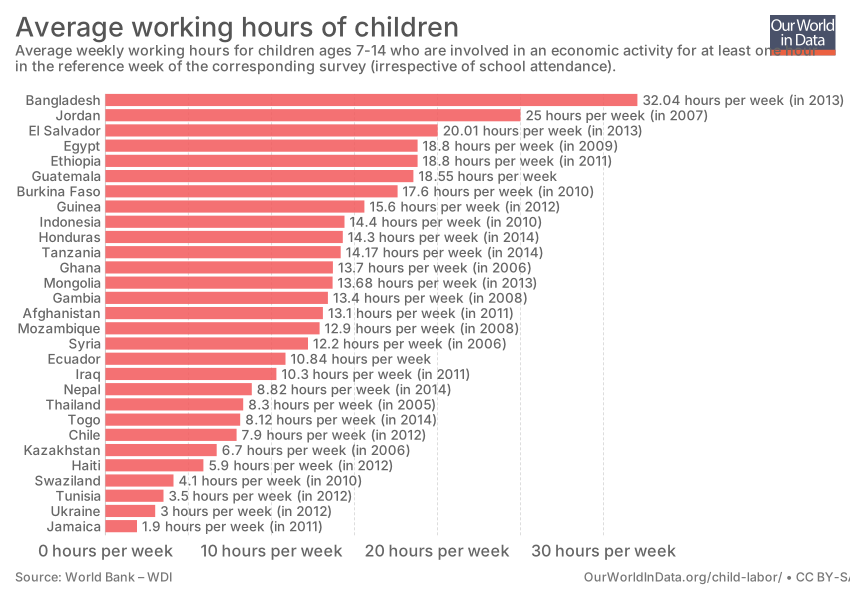
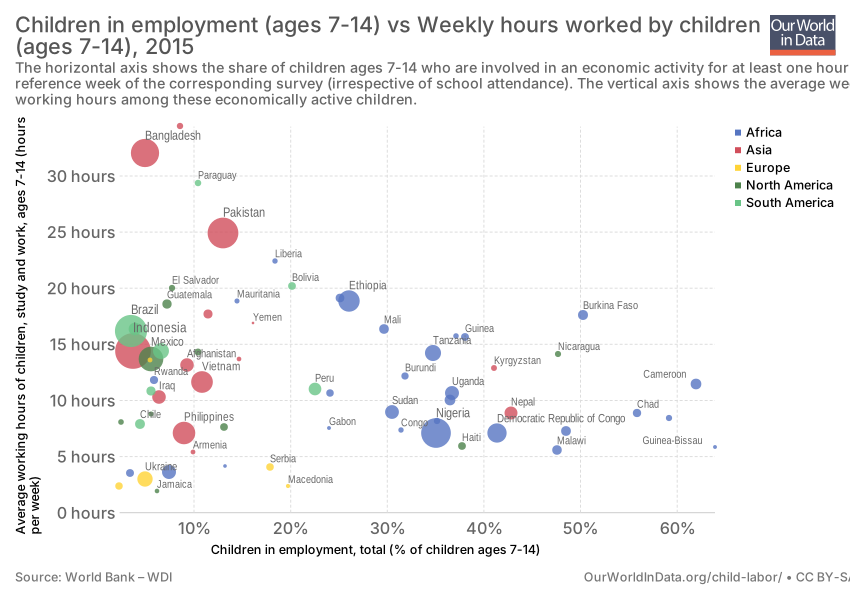
While this is anecdotal from War on Want Ourworldindata, from which Pinker takes most of his graphs show the level of child labour in Bangladesh (as well as other developing nations):


 The richest 50:


I also think it's of vital importance that when talking about wealth and poverty we don't use Pinker's absolute measures but rather look at relative poverty and wealth inequality. Oxfam figures tell a very different story to Pinker.
Using rates rather than numbers is that that can hide serious problems. So for instance, malnutrition and hunger, Pinker shows, is going down. Or rather the rate is. Because the world population is increasing so markedly. There are actually more people going hungry in the world. The latest figures from WHO show not only the number of people going hungry has risen but the rate has also risen, due, ironically to climate change and conflict.
While Pinker asserts that GDP growth is always good and that it doesn't mean emissions all the data shows the opposite effect...Just to remind you and harp on about how can we be progressing when we're destroying the home we live on...


Pinker's view of economic growth mirrors the 'trickle down effect' advocated by Thatcher and Reagan in the 80s, wealth is good for all because all will share in it. But in the US, as an example the wealth gap is growing exponentially.


A key indicator of the economic health of any nation is social mobility. And in the US and UK as examples, this is now at its worst since WWII.

The number of billionaires in the world grows, as does their wealth.

But to reiterate the bottom 50% have seen no rise in wealth in 2017.
You can break down C02 emissions by a country's wealth. US produce 15% of the world's emission with a 4% population, which contradicts Pinker's statement that as countries get wealthier they become more environmentally responsible.
Global slavery figures are very unreliable it's true but if you can use self reported happiness indicators in an argument then why the hell not use The Global Slavery Index showing slavery is at present four times that of the whole transatlantic slave trade...

So to end (at last) in anally retentive bullet point form some key areas that Pinker rather handily left out because they don't fit his thesis:
That's the question that Steven Pinker poses in his new work Enlightenment Now and he argues humanity is progressing in just about every way that you can powerpoint a graph at.
This got me thinking not just about Pinker's views but about what progress actually entails. Is it linear? Is it just about humans? What of the rest of the natural world? How do you measure progress? Whose view is pre-eminent? Does human progress involve non-humans, animals, nature things like trees and whatnot?
In Pinker's talk on RSA...
He rightly questions whether enlightenment values are under threat. The obvious examples being fake news, Trumpism (which is surely in itself an argument that the nation that gave us Washington, Jefferson, FDR, etc. is not only a world laughing stock but a symbol of deterioration), regression of democracy in Poland, Turkey, Russia, etc., the re-emergence of religious belief, especially Islamic fundamentalism.
He posits that the enlightenment values were Reason, Science and Humanism.
He, again, rightly points out that humans are not generally reasonable. We, as a species, he suggests, tend to "prefer anecdotes, stereotypes, we seek evidence that confirms our beliefs and ignore evidence that disconfirms them, and we're over-confident about our knowledge, wisdom and rectitude."
He could add we're prone to self delusion and cognitive dissonance. For oddly, Pinker then blithely uses these unreasonable ideas in his pursuit of proving his thesis.
He's happy to rely on anecdote, citing people self reporting happiness and then linking this to wealth and reasoning thus that as we get wealthier we get happier.
He opens his talk with the anecdotal certainty that "Intellectuals hate progress. And intellectuals who call themselves progressive really hate progress." He doesn't need scientific reasoned evidence for this bold statement.
So what is this progress that all intellectuals hate?
"If we apply knowledge and sympathy to reduce suffering and enhance flourishing we can gradually succeed."
Succeed at what? Life? Sport? Making the ideal blancmange? It's really not clear. But what is clear, and I intend to argue the case, is that using this template humanity has not progressed. Is not succeeding.
Necessarily I'm going to critique Pinker and set out ways in which he very clearly seeks evidence that confirms his beliefs and ignores evidence that disconfirms them. That he is indeed over-confident in his own knowledge, wisdom and rectitude and that his definition of progress is limited to an extraordinarily narrow set of human endeavours in which the very actions that create that progress are setting in motion symptoms of a deep malaise that defies the enlightenment values he espouses. The obvious example being climate change.
I'll explore this idea further later but how can we be progressing by harnessing the knowledge of technology, industrialization and global economics whilst these very things are the means by which we are destroying our own eco-system? That makes no sense as progress, as a road to succeeding.
I'm going to highlight Pinker's narrow vision of progress as simple wealth creation. His equation being that wealth makes us happier, safer, better educated, and ultimately more caring. Apart from arguing that that's all incorrect, I want to point out that there are numerous factors he avoids in his vision of progress. Again, climate change is hardly mentioned, of course. Also, he argues that a cornerstone of enlightenment values is humanism, not only how we treat each other as people but he highlights how we treat other sentient beings, yet he never mentions industrialized factory and mega farming. He doesn't touch on the arts in this argument but elsewhere, in his book The Blank Slate he points out that our postmodern world is lacking a direction in art, in our consumption and production. What of thought? Culture? Have we progressed? Where are the philosophers, the artists, the great composers of our age?
An important factor in Pinker's arguments are that rates of many negative aspects of human endeavour, crime, for instance, and positive aspects, longevity, literacy, and so on, have increased markedly in the late twentieth century and into the 21st. When looking at his data it's important to remember that it is about rates of growth or decline not numbers. Thus, murder rates may have fallen but there may be more murders. The simple fact is that the world population increased markedly in the twentieth century.

This is a chart that Pinker uses to show population growth rate is plummeting. Yet counter intuitively, it's important to remember that world population is going up. It went from just over 1.5 billion to over 6 billion in the 20th Century (more than a threefold increase). In the 18 years of the 21st Century it's grown by over 1.5 billion.
It's perfectly reasonable for Pinker to use data that is the rate of decline or growth, most agencies do. So take murder rates in the US as an example.

US murder rate

US population growth
It's actually quite hard to find the numbers of murders in the US but since 1990 there appears to have been a fall in actual murders as opposed to the rate in major cities. But this trend has bucked in 2015 and 2016 by 10.8% then a further 8.6%. Far too early to tell if this is a new trend.
My point is that huge population growth spurts can skewer data. In the beginning was the word and the murder rate was 25% of all humanity thanks to Cain.
So let's look at Pinker's data before I offer up a different vision of progress.
Pinker shows life expectancy has shifted upwards markedly since the late 19th Century. No argument with the figures but then there is a moral, if not philosophical argument over whether that is an objectively progressive thing. It seems it on the face of it. We live longer, yay! That has to be progress. But if you look at not only what the purpose of life is but also what we do with that life then the idea could be problematic. An early human would be lucky to survive to the age of 30. Post agricultural between 8-16000 years ago when farming took hold it seems not to have really made much difference. In Ancient Greece, the pinnacle of civilization, the average peasant was very unlikely to see the ripe old age of thirty. But our environmental impact is growing. If we live longer our impact is greater. I'm not a eugenicist but a growing ageing population is problematic for the environment and public spending and for having to spend time with old people yacking on about their grandkids. They smell funny too.
Sanitation plays the biggest part in our longer living lives, as Pinker argues. And I'm all for sanitation.
Sanitation plays the biggest part in our longer living lives, as Pinker argues. And I'm all for sanitation.

And child mortality plummets in the same period.

Calorie intake has increased thanks to "developments in agronomy, crop rotation, later, selective breeding of vigorous hybrids."
"One could say this is dubious progress as it simply consists of the fat getting fatter," Pinker argues and then shows a graphs...


Oops, no they're mine. He avoids child and adult obesity completely (as well as the cost in agriculture to biodeversity) and shows a graph highlighting cuts in undernourishment...

Great but doesn't actually answer his own question there about the fat getting fatter.
There's a point to that.
Figures for developing nations is where the rate vs the numbers becomes problematic. Partly because in developed nations population numbers have stagnated so the huge rise in numbers (not by population rate) is in the developing nations. This tends to skewer data. Less people are going hungry by rate of population but some figures suggest in actual numbers that there are more people living in conditions of hunger or malnutrition now:

And I'm not above using dubious self reported data to show even in the richest country in the world people claim to go hungry...

Now all this data shows more of us live longer, have babies that survive and we can feed them. Objectively, this seems like progress. And life expectancy and child mortality and population growth are, of course, inextricably linked. But what if population growth and the way we feed ourselves are actually bad for humans and sentient beings, the cornerstone of humanistic thought, as a whole if you factor in things like, the most obvious, climate change, consumption of animals, 'real' numbers of people in poverty and hunger, even factors like unemployment, the coming of AI, or in real term numbers, the amount of people who are murdered, commit suicide, experience violent crime, and so on.
If the sheer number of people makes the planet we live on unsustainably polluted and has lead to industrialized factory farming practices, is that still progress?
If you select data without any comparisons or questions then it can seem, well, unquestionable.
Pinker moves onto prosperity, really a key argument in his thesis. Growth is good. And Pinker shows a huge spike in growth during our industrial revolution.


Well, that's a but uncanny isn't it?
"Again, with that if that were just a question of the rich getting richer then it would perhaps be a dubious form of progress. But in fact it's the poor that are getting uh....um...you know being lifted out of universal wretchedness."
Which has to be one of the most brilliantly twisted logical fallacies.
So instead of looking at rich getting richer and poor getting poorer he just gives us a graph of objective extreme poverty that tells us very little in the scheme of things (other than purely historical). All data shows that wages have stagnated since the 80s for all but the wealthiest. Social mobility, the best marker of a healthy progressive society, is plumeting back to pre war figures, just as wealth inequality does too.

Thomas Picketty has shown that the poorest in the developed nations are getting poorer whilst the share of wealth for the top 1% has skyrocketed in recent years.


There's masses of data like this showing that, in particular, the US and UK (and most of Pinker's data is based on these two economies) are the worst for social mobility and they are getting worse.


But this is a world problem. Oxfam suggest that: "Eighty two per cent of the wealth generated last year went to the richest one per cent of the global population, while the 3.7 billion people who make up the poorest half got nothing."


And perhaps even more importantly, the wealthier nations get the more they pump C02 into the atmosphere:

Which is bad for us all, but worse for the poorest. In fact every projection for climate change projects far more severe hardships for the poorest nations:


And climate change and inequality are inextricably linked.
So Pinker does a great sleight of hand, "as a result because poor countries are getting richer faster than rich countries are getting richer international inequality has been declining...even though inequality within rich countries has been increasing."
Though oddly he doesn't offer up a graph or any data for this. I couldn't find any that was clear cut.
At least he does recognize that inequality within nations is growing but limits that to rich countries. Unfortunately, this is not true. The same is happening in developing nations from China, India through to Pakistan and Bangladesh.


At least he does recognize that inequality within nations is growing but limits that to rich countries. Unfortunately, this is not true. The same is happening in developing nations from China, India through to Pakistan and Bangladesh.


So Pinker offers up a graph of absolute (not relative, i.e. not between wealthiest and poorest) poverty in the US.


On Peace, Pinker offers us a graph on when "the great powers were at war with each other."

By great powers I presume he's meaning US, Britain, France, Russia, etc. See how it dips so after WWII. You know, that point when we obtained the atom bomb.
This is a redundant graph. Surely there are better ones to show the world is more peaceful?
I think there's a quite a lot of data to show we're killing each other less in wars. That might well, indeed, be progress.
There's data on democracy vs autocracy, showing a marked increase in democracies, though I'm not sure of his data as it shows a marked increase since the 2000s. Really? I'm struggling to think of a country that recently become democratic but can name many that have gone the other way, Russia, Egypt (theoretically), Turkey (maybe?), US (joke).
"Capital punishment could disappear by the 2020s," claims Pinker. Really? He doesn't show data.

The US has been quite static


Executing/abolutionist country ratio is pretty static too. Most are fundamentalist Islamic countries. Can't really see that changing soon.
Pinker highlights the legalization of homosexuality in most of the world and that very obviously is progress.
Child labour is down.

But not by much.


As long as the US and other developed countries profit so enormously from it then it isn't going to end.
Pinker shows that homicides are down. Except in the US where there's the upward trend of the last three years.
It's safer in the world (if you don't count the effects of climate change) and literacy is up though that doesn't seem to have a qualitative effect. on say, voting in the US election or a Brexit referendum.
Talking of which, IQ is up. The well known Flynn effect shows we just keep on getting smarter.
Talking of which, IQ is up. The well known Flynn effect shows we just keep on getting smarter.

Of course, the obvious criticism of the Flynn effect is that if we're gaining 3 points every ten years then your roughly 9 points smarter each generation so a measurement of your children over 100 years ago puts them on the borderline of "retardation." As Megan Gambino in The Smithsonian Magazine suggests:
What goes on in the person’s mind in the test room that allows them to do better on the test? One of the fundamental things is the switch from “utilitarian spectacles” to “scientific spectacles.” The fact that we wear scientific spectacles doesn’t mean that we actually know a lot about science. What I mean is, in 1900 in America, if you asked a child, what do dogs and rabbits have in common, they would say, “Well, you use dogs to hunt rabbits.” This is not the answer that the IQ tests want. They want you to classify. Today, a child would be likely to say, “They are both animals.” They picked up the habit of classification and use the vocabulary of science. They classify the world as a prerequisite to understanding it."
If this were not the case then everyone prior to the 20th Century were gibbering idiots. It's a different intelligence. One could argue, if you buy Gambino's argument (as I do) that we're better at remembering patterns and classifications but now know less about the real world. That really doesn't sound like progress to me.
"Does this all improve our quality of life? Well, in just about every way you want to measure it it has."
Which is a bold statement. Every measure? I don't even know how you would measure that measurement. Pinker highlights that the average worker has seen their hours cut from 62 a week to this:

This is why Pinker gets accused of cherrypicking data. Why does the data only include Western Europe and the US? Why does it only go up to 2000? Why is it clearly on an upward curve here in the US?


Here's just some random data post 2000 from the US. That weirdly doesn't look like progress to me.
"Thanks to the penetration of refrigerators, vacuum cleaners, dishwashers...the amount of housework people do has fallen from nearly 60 hours a week to 11 hours a week."


Again, this is US data extrapolated to womankind the world over. Dishwashers? Microwaves? Really? Even I don't have those and I'm a wealthy Brit.
So now we have lots of leisure time argues Pinker:

Yes, more US data selected from 1965 to 2015 extrapolated to mean everyone. I wonder how that fits in with the developing nations emergence, China and India, say. How does it fit with the average garment worker or child labourer?
"In Bangladesh, 3.5 million workers in 4,825 garment factories produce goods for export to the global market, principally Europe and North America. The Bangladeshi garment industry generates 80% of the country’s total export revenue. However, the wealth generated by this sector has led to few improvements in the lives of garment workers, 85% of whom are women.
The majority of garment workers in Bangladesh earn little more than the minimum wage, set at 3,000 taka a month (approximately £25), far below what is considered a living wage, calculated at 5,000 taka a month (approximately £45), which would be the minimum required to provide a family with shelter, food and education.
As well as earning a pittance, Bangladeshi factory workers face appalling conditions. Many are forced to work 14-16 hours a day seven days a week, with some workers finishing at 3am only to start again the same morning at 7.30am."
While this is anecdotal from War on Want Ourworldindata, from which Pinker takes most of his graphs show the level of child labour in Bangladesh (as well as other developing nations):
32 hours for 7-14 year olds, it seems perfectly feasible that adults would be working twice as long.
Child labour is actually still widespread. And as mentioned above, these are primarily benefitting western economies.
Interestingly, on ourworldindata blog by Max Roser, which as I say, Pinker uses extensively there is no data for world work hours, merely for the US and western Europe up to 2000.
In fact I challenge anyone to find working hour data that includes the developing nations. I can't.
Here's one for millenials that actually factors in India:

But it's hard to see how the myriad workers in factories in Bangladesh, India, Pakistan or indeed, even China have seen this wonderful progress in work hours and leisure that Pinker alludes to.


Now we get to happiness.
"Well does it makes us any happier? Well we don't have figures for the world as a whole but we do know that happiness is related to income. This is the regression line for average national happiness assessed by the simple expedient of asking people as a function of the log of GDP. The richer the country the happier its citizens."

An incomprehensible blur to back this up but pinker tells us "As countries get richer as all countries have been doing it means on average their citizens are getting happier."
Aha! All countries have got richer. That is a wilddddddddddd overstatement. One would have to randomly pop in, say, "Greece GDP by year" and find...

As to the richer the country the happier you get...The happiest 50:


Data on richest economies is available on most business sites like ceoworld and happiness is from the data at sciencealert from the UN happiness index.
Qatar are the richest yet are vaguely miserable sitting at 36th in our happiness chart. Luxembourg in at number 2 in wealth scrape into the top 20 of happy at number 20. In fact wealth seems to have much less effect than those with social democratic governments and less inequality:

Looking at wealth generation leading to happiness you should see all these lovely oil and gas rich countries whooping it up like it's 1999:

Yet the richest, besides Qatar, are the UAE, Kuwait and Turkmenistan, coming in at 28, 41 and 634th* in the happiness index.
* that's an estimate as Turkministan aren't on the happiness index.

Hands up Turkmenistani women if you are happy...ah science.
Obviously, being a discussion on enlightenment Pinker points out at the very beginning of his talk that reason, being the cornerstone of the enlightenment, "is non negotiable, as soon as you try to provide reasons why you should trust anything other than reason, why you're right, why other people should believe you, that you're not lying or full of crap you've lost the argument...cognitive psychologists have shown we generalize from anecdotes (remember "intellectual hate progress"). We seek evidence that confirms our beliefs, ignore evidence that disconfirms them."

So it's bizarre that Pinker is (reportedly) happy to use self reported happiness indicators as factual empirical evidence for his thesis. The world is getting richer, the world is getting happier.
While Pinker remember points out that humans are unreasonable he also suggests IQ is going up...
We're getting smarter. Look at our American cousins shooting off into the brain stratosphere of genius. To me, this is a very good way at looking at progress. How much more intelligent are we? How more enlightened? How less prone to believing superstitious sky gods control our destiny?
So you have to wonder why "The percentage of Americans who believe in God or a universal spirit has remained near or above 90% for the past 60 years." Or "Since 1997, belief in heaven has ranged between 72% and 83%. According to Gallup's most recent May 2004 Values and Beliefs poll, 81% of Americans currently say they believe in heaven, 10% are unsure, and 8% do not believe."
Only 8% do not believe in a magical afterlife kingdom.

Heaven. Ooops that's Oz...heaven
"From 1997 to 2004, belief in hell has ranged between 56% and 71%. The 2004 data reveal that 70% of Americans overall believe in hell, while 12% are not sure and 17% do not believe in hell."


"In 1994, 72% of Americans said they believed in angels, and that percentage has increased to 78% today."

Ah progress.
But Pinker saves his best data and assertions until last.
He argues that optimism is better than pessimism, which leads to "the danger of fatalism." He argues optimistically that "there are problems like climate change and nuclear weapons but we can look at them as problems to be solved in the future as we've solved problems in the past."
He doesn't clarify what problems we've solved as clearly even from his own cherrypicked data we haven't solved any of the problems he highlights, they, to him, have merely got better.
But how do we solve climate change?
"Through decarbonisation..." says Pinker.

Except the exact opposite has happened and we're well over the 400ppm threshold and almost certainly not going to meet the Paris agreement of "trying to limit warming to 1.5 degrees Centigrade."
So Pinker suggests "believe it or not there has been progress" and he shows us a graph of CO2 emissions against GDP:

..."which peaked in the 1960s and shows the trajectory industrializing countries can undergo."
Which is utterly meaningless.
So you think, right, he's going to show a graph now of an industrialized country to show you can be industrialized and lower emissions...So we get a graph on the UK.

First off this is very very naughty Mr P, selecting the UK who has next to no industrial base and relies on 80% of its GDP from the service industries. But much worse is Pinker's assertion that "here you can see the UK as it switched from wood to coal to oil to gas and renewables it peaked in its emissions of carbon per unit of wealth created." Here's a breakdown of that great new dawn in Britain's renewable use:

By 2017 the figures had moved to:
Gas 43%
Renewables 27%
Nuclear 23%
Oil 4%
Coal 3%
Which still sounds better. What the data doesn't tell you is that most of this was imported. Gas can be as bad as coal or oil (we're moving to fracking which has a terrible water use/pollution record) due to methane emissions, but most damning is that renewables is substantially represented by biomass....
In the UK that means wood burning, exactly what Pinker claims we've moved away from:
"Although environmentalists dispute the idea that wood-burning is green at all, it is still officially considered low-carbon by the UK and EU. The UK’s biggest power station, Drax in North Yorkshire, has already converted three of its six units from coal to biomass, and is exploring switching a fourth."
Pinker also quickly mentions that "here we see India going through the same process" and it's so quick you can't see the data. I wonder why?

Perhaps because it isn't going through any such thing but its emissions are rising steadily. But he's, of course, disingenuously measuring CO2 emissions by GDP rather than emissions per se.
"Of course these have to brought to zero which will be extraordinarily difficult but what this graph shows is that its a process that we can accelerate."
Didn't Pinker say that reason was not about "talking crap"? This is just complete crap. Zero? So we're going to give up cars, air travel, oil, plastics, eating meat and dairy, having babies, etc. want-to-fight-climate-change-have-fewer-children? We won't even limit it to 1.5C warming let alone decarbonize to zero emissions. That's just plain nonsense.
Pinker concludes with "Is humanism...boring? Do people need to believe in a father in the sky, magic, myths of heroic ancestors?" No, says Pinker and I agree with him, absolutely not, of course. Yet we do. And no doubt will do even more so in the bright shining futureworld....

Now, a criticism of anyone who criticizes Pinker's data is that you must (it's the law) offer an alternative vision. I've questioned his data but what would you Mr Hughes have in your data to show that Steven pinker's rosy view is wrong?
Well, first I'd question his notion of progress. Is the world as a whole getting richer really the best way of measuring progress? After all, if the world were a human being we would not measure their progress by their wealth surely? Health maybe? We live longer but we're much much much fatter.
In the US a third of all adults are obese. Not just fat but really really scientifically measured fat.
In my own data I would suggest that the world has got better in a number of ways. First off, as Pinker alludes to it's a better world for personal expression (in general). In the west at least, it's the best time to be gay or transgender or even disabled. Ethnic minorities are far more equal than in the past. Gender inequality is still terrible but it's better than it was. It's an irony that our postmodern post 1960s "many individual truths"culture has promoted freedom of individual identity, ironic as Pinker rails against postmodernism.
Using rates rather than numbers is that that can hide serious problems. So for instance, malnutrition and hunger, Pinker shows, is going down. Or rather the rate is. Because the world population is increasing so markedly. There are actually more people going hungry in the world. The latest figures from WHO show not only the number of people going hungry has risen but the rate has also risen, due, ironically to climate change and conflict.
While Pinker asserts that GDP growth is always good and that it doesn't mean emissions all the data shows the opposite effect...Just to remind you and harp on about how can we be progressing when we're destroying the home we live on...

GDP

CO2


A key indicator of the economic health of any nation is social mobility. And in the US and UK as examples, this is now at its worst since WWII.

The number of billionaires in the world grows, as does their wealth.

But to reiterate the bottom 50% have seen no rise in wealth in 2017.
You can break down C02 emissions by a country's wealth. US produce 15% of the world's emission with a 4% population, which contradicts Pinker's statement that as countries get wealthier they become more environmentally responsible.
Global slavery figures are very unreliable it's true but if you can use self reported happiness indicators in an argument then why the hell not use The Global Slavery Index showing slavery is at present four times that of the whole transatlantic slave trade...

So to end (at last) in anally retentive bullet point form some key areas that Pinker rather handily left out because they don't fit his thesis:
- High art. (Pinker argues in his book The Blank Slate that high art has seen a terminal decline since WWII).
- What of indigenous cultures? As he's North American I'd like to see some healthy data on 'Native Americans'.
- What of modern problems like road rage, social media abuse, online grooming?
- Gentrification of our cities and its long term effects.
- Mass consumption to which Pinker does answer elsewhere: "The intellectual and cultural critics who make that argument never seem to include trips to the continent or fine food and wine as a sign of soulless materialistic consumption. It’s always consumption by the other guy that they think of as morally compromising. There’s an issue with the effects on the environment: it really is not good to pollute the environment, particularly when it comes to carbon emissions, but the way to deal with that is not to rail against consumption. There are a lot of aspects of consumption, like being able to travel, see the world, be warm in the winter, cool in the summer, that are human goods. The challenge is: how do we get the most human benefit with the least environmental damage?" Guardian Feb 2018. Which apart from the obvious straw man of imaginary hypocritical critics is just plain wrong in every aspect.
- Factory and mega farming Yuval Noah Harari
- Use of fertilisers Farming is 'single biggest cause' of worst air pollution in Europe
- Bee loss
- Animal species loss
- Litter
- Plastic pollution in the oceans and rivers
- Ocean warming and ice loss at the poles
- Rise in violent crime in the US and UK ONS
- Trafficking
- Prisoner numbers (which are rising in the US and UK)
- Drug crime
- Hate crimes
- Tax avoidance by both:
- individuals
- corporations
- Inequality within nations
- Terrorist deaths
- Religious fundamentalism
- Education costs
- Mental health
- Rise of nationalism
- homelessness
- loss of affordable housing
- zero hour contracting
- unemployment
- Oh you know, stuff.
Comments
Post a Comment